Cold Storage Pallet Sizes: 1200×1000, 1100×1100 and Custom Options for Freezer Rooms
 Nov 13, 2026|
 View:3
A freezer room is one of the few places where 50 mm decides money. Order 1200 × 1000 mm pallets for racking built around 1100 mm openings and loads no longer sit on the beams; order 1100 mm units for a European DC and every conveyor transfer misreads. The cold storage pallet size is not a packaging detail — it is what your racking, doors and trucks were designed around.
This guide shows how freezer slots and footprints actually match, compares the three sizes that cover most cold rooms, explains what sub-zero does to tolerances, works through stack height and aisle width, and closes with sampling and lead time.
Key Takeaways
Size is set by the slot, not by the catalogue. Rack opening width, beam span, slot height and door width define the usable cold storage pallet size before any load rating does.
1200 × 1000 mm is the most common choice for mixed frozen goods; 1100 × 1100 mm suits legacy square racking; 1200 × 800 mm buys density for narrow loads.
Plastic contracts in a freezer. Allow roughly 0.5–0.8% linear movement between ambient and -25 °C, or 6–9 mm across a 1200 mm deck.
Clearance is cheaper than redesign. 20–30 mm per side in a rack slot and 100 mm vertically avoid most freezer damage.
Custom footprints start with a drawing, not a price list: tooling, sampling and the standard 15–20 day production window are quoted separately.
1. How Cold Room Slots Decide Your Cold Storage Pallet Size
A pallet position in a freezer is a box with four dimensions: opening width between uprights, beam span front to back, clear height between levels, and the width of the door or airlock the load must pass through. A pallet that satisfies the load rating but not those four numbers will be re-ordered.
Four numbers to measure before quoting
Opening width. Two pallets per bay is the norm: a 2550 mm opening takes two 1200 mm pallets with 75 mm each side, a 2350 mm opening two 1100 mm pallets.
Beam span and bearing. Allow 50 mm minimum bearing per side, 60–75 mm is comfortable; a 1100 mm pallet in a 1200 mm span leaves only 50 mm.
Slot height. Load height plus 100 mm for fork entry, plus 20–30 mm where ice builds on beams.
Door and airlock width. The limiting dimension is often the diagonal: about 1562 mm for 1200 × 1000, 1556 mm for 1100 × 1100 and 1442 mm for 1200 × 800.
Why the footprint changes the whole aisle
Slot count is decided by repeated addition. In a 20-bay aisle a 50 mm wider pallet can remove a bay, and 100 mm can remove a position per level on every bay. That is why the answer to "what cold storage pallet size should we standardise on" comes from the racking drawing first, the load table second.
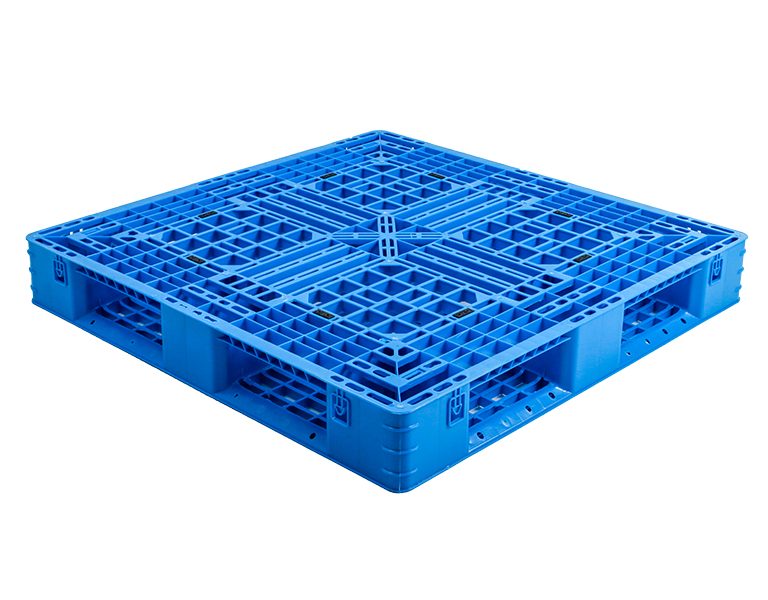
2. 1200 × 1000, 1100 × 1100 and 1200 × 800 Compared
Three footprints cover most freezer rooms. The table uses published dimensions and load ratings from moulded HDPE pallets. Each plastic pallet standard size in use came out of a racking and trucking standard, not a freezer.
| Item | 1200 × 1000 mm | 1100 × 1100 mm | 1200 × 800 mm |
|---|---|---|---|
| Deck area | 1.20 m² | 1.21 m² | 0.96 m² |
| Diagonal (door check) | ≈1562 mm | ≈1556 mm | ≈1442 mm |
| Typical height | 150 mm | 150 mm | 135–150 mm |
| Typical weight, HDPE | 11–13 kg | 9–12 kg | 10 kg |
| Dynamic / static / rack load | 1,000 / 4,000 / 800 kg | 1,000 / 4,000 / 800 kg | 1,000 / 4,000 / 800 kg |
| Forklift entry | 4-way on most moulds | 4-way on most moulds | 2-way or 4-way |
| Pallets per 2-pallet bay | 2 per ≈2550 mm opening | 2 per ≈2350 mm opening | 3 per ≈2550 mm opening |
| Strengths in a freezer | Widest equipment support, good stability | Square deck, generous beam bearing | Highest slot density, narrow aisles |
| Watch out for | Wider doors and aisles needed | Legacy racking only in some regions | Tall loads tip more easily |
Figures are published catalogue values for standard HDPE moulds, not sub-zero certifications. Confirm tested values at your operating temperature for the exact model.
When 1200 × 1000 mm is the right answer
It is the default in most frozen food and 3PL sites because forklifts, conveyors and trailers are built around it. A 1200 x 1000 plastic pallet typically rates 1,000 kg dynamic and 4,000 kg static, and its 1.20 m² deck spreads load better than a Euro mould, which matters for cartons that creep.
When 1100 × 1100 mm still wins
Square pallets remain common where racking was bought for them. The 1100 x 1100 plastic pallet gives 1.21 m² of deck in a footprint 100 mm narrower than a 1200 mm pallet, so it fits two per bay in buildings that cannot be re-racked. Beam bearing is generous and the square deck loads evenly.
When 1200 × 800 mm buys density
The European footprint stores three pallets in the width of two 1200 mm units, raising slot count in a fixed building. The trade-off is base area, 0.96 m² against 1.20 m², so tall stacks need careful centring and suit cartoned goods rather than unstable bulk.
Send your freezer slot drawing — opening width, beam span, slot height and door width — and receive a size recommendation with tested load ratings.
Get a Size RecommendationSend Slot Dimensions3. Dimensional Stability and Clearance at -25 °C
Polyethylene moves more than steel or concrete. Between a 20 °C dock and a -25 °C freezer, a moulded HDPE pallet changes length by roughly 0.5–0.8%, depending on resin grade and how much the ribs restrain movement.
On a 1200 mm side: 6–9 mm of contraction.
On a 1100 mm side: 5.5–8 mm.
On a 800 mm side: 4–6 mm.
Those numbers look small until they meet an automation system: a conveyor or AS/RS that accepts ±10 mm leaves no margin once contraction, mould tolerance and wear add up. The rule: build clearance into the equipment side and never size a freezer pallet to the exact opening.
Where the clearance belongs
Rack slot: 20–30 mm per side, 50 mm total minimum, so a contracted pallet still lands inside the uprights.
Beam bearing: keep 50 mm minimum contact after contraction; a 1200 mm pallet on a 1250 mm span has 25 mm per side before shrink.
Vertical: 100 mm per level for fork entry, plus 20–30 mm where ice forms.
Doors: 100 mm each side of the diagonal, 50 mm above a threshold where ice builds.
Steel-reinforced cold storage pallets: steel moves about a tenth as much as HDPE, so inserts must be sealed and the pocket design must tolerate the difference.

4. Stack Height and Aisle Width for Each Cold Storage Pallet Size
Two calculations decide how much frozen stock a room actually holds: how high a load can be stacked, and how much floor the forklift needs to turn.
Stack height from the static rating
Floor stacking puts every pallet above on the bottom unit, so the static rating sets the limit, not the dynamic one. A working method is to divide the static rating by loaded weight per pallet with a 1.5 safety margin:
Static 4,000 kg ÷ (600 kg × 1.5) ≈ 4.4 → four tiers. At 1,000 kg loads the same pallet supports two tiers comfortably; five is where deck fatigue starts. In racking, slot height sets the limit: an 8 m room with 1.6 m slots gives five levels at 800 kg each.
Aisle width from the truck, not the pallet
Aisle width is the truck's right-angle stacking aisle: turning radius plus load length plus 100–200 mm clearance (traffic and pedestrian rules around those aisles sit in this warehouse safety guidance). Typical figures for 1200 mm pallets on a flat freezer floor:
Counterbalance truck, 1.5–2 t: 3.5–4.0 m
Reach truck: 2.7–3.0 m
Very narrow aisle (VNA) turret truck: 1.6–1.9 m
Powered pallet truck only: 2.0–2.3 m
Footprint enters through load length: a 1200 mm pallet needs about 100 mm more aisle than a 1100 mm unit at the same truck, and a 1200 × 800 mm pallet narrows the overhang the truck must swing. Where aisles take 10% of the floor, moving from counterbalance to reach trucks frees more capacity than changing pallet size — but changing size is cheaper.

5. Custom Sizes: Sampling, Tooling and Lead Time
Standard sizes cover most rooms, but three situations justify a custom mould: racking built to a non-standard opening, an automated line with a fixed transfer width, and a height limit set by doors or an existing stack. Then the cold storage pallet size is drawn to the slot instead of chosen from a list.
What to send with an enquiry
Footprint and height with tolerance, e.g. 1240 × 1040 × 150 mm ±3 mm.
Three load ratings — dynamic, static and rack — plus the beam span they refer to.
Entry sides (2-way or 4-way) and fork pocket height.
Operating temperature and dwell time, to match resin and additives.
Annual volume, colour reference and marking, which drive tooling and minimum order.
Sampling and delivery sequence
Work in this order: drawing review, sample, cold test, production. Samples ship by express courier so the buyer can measure and load-test first. For standard moulds with custom colour or logo, production typically runs 15–20 days after payment at a 300-piece minimum; a new mould carries its own tooling cost and terms, quoted per drawing and outside that window. Cold-test the sample for 48 hours at the real temperature, then measure again.
Two links belong in the specification: the sub-zero pallet engineering guide covers resin and additives, and custom pallet manufacturing covers colours, marking and tooling. Buyers shipping frozen goods on mixed fleets should note that wood pallets need heat treatment or fumigation under the international wood packaging treatment standard; moulded plastic units do not.

Have a drawing or a slot that standard sizes do not fit? XuanSheng reviews footprints, load ratings and temperature range before quoting tooling.
Get a Custom Quote

Conclusion
Choose the cold storage pallet size from the building outward: opening width, beam bearing, slot height and door diagonal first; load rating second; material third. 1200 × 1000 mm is the safe default, 1100 × 1100 mm keeps square racking working, 1200 × 800 mm adds slots where loads are stable. Then allow for contraction and prove the choice with a cold sample.
Whatever the drawing gives, write the specification down: dimensions with tolerance, the three load ratings with beam span, operating temperature, entry sides, colour and annual volume. Suppliers who receive those lines quote a match instead of a guess. The full plastic pallet range shows the standard moulds available before a custom tool is discussed.
FAQ: Cold Room Pallet Sizes
What is the standard cold storage pallet size?
1200 × 1000 mm is the most widely used; 1100 × 1100 mm is common where racking was built for square pallets, and 1200 × 800 mm suits dense European-style storage.
Do plastic pallets shrink in a freezer?
Yes, roughly 0.5–0.8% linear contraction between a 20 °C dock and -25 °C, or 6–9 mm across a 1200 mm deck. Allow clearance rather than trusting the nominal size.
Can a standard pallet be used at -30 °C?
Often yes, but check it: resin grade, low-temperature additives and rib design all affect impact behaviour. Ask for data at your temperature, or cold-test a sample for 48 hours.
How much clearance should a rack slot have?
20–30 mm per side and 50 mm total, plus 100 mm vertically for fork entry; add 20–30 mm where ice builds on beams.
What aisle width do 1200 × 1000 mm pallets need?
Typically 3.5–4.0 m with a counterbalance truck, 2.7–3.0 m with a reach truck and 1.6–1.9 m in a VNA system; confirm with the truck supplier.
What is the lead time for a custom size?
Standard moulds with custom colour or marking run 15–20 days after payment at a 300-piece minimum; a new mould is quoted separately.
Ready to fix the footprint? Submit your freezer slot dimensions, load per level and annual volume — the reply includes a size recommendation and a quotation.
Submit Slot SizesContact Us